Showing posts with label BAME. Show all posts

Monday, 1 June 2026

Petition to get debate in Parliament on prostate cancer screening.

So I heard on the news this week that the UK National Screening Committee (UK NSC) finalised its recommendations on prostate cancer screening, limiting this to men with a known BRCA2 gene variant who have relevant family history. Sadly this recommendation excludes the vast majority of men, including those at highest risk, such as Black men and those with a family history, and falls far short of what is needed to save lives through earlier diagnosis. 

As noted previously in this blog the issue of PSA tests is not straight forward and has led to over treatment in many cases. However it is clear to me that those at highest risk should be part of a screening programme. Do consider signing the petition at teh end of this post.

Here's part of an email with details of the new petition from Prostate Cancer research:

"We are deeply disappointed....But while this is not the outcome we fought for, it is not the end of this campaign. Because of you, we have built something powerful. Over the past two years, more than 300,000 of you signed our petitions. Tens of thousands of you wrote to your MPs. As a result, more than 250 MPs from across political parties have signalled their support for change. 

You helped unite 18 leading organisations across the clinical, charity and research community behind a shared call for reform, and brought major national newspapers, including the Daily Mail, The Telegraph and The Times, firmly behind this issue. This support has continued over the last few days, with the UK NSC recommendation generating significant national media attention, with coverage across The Times, The Telegraph, the Daily Mail, the BBC, GB News and many others, many expressing strong concern about the implications of the recommendation. 

Your support also made it possible for us to commission an independent review of the UK NSC’s modelling by the York Health Economics Consortium (YHEC). That review identified serious flaws in the model underpinning this decision, including assumptions that do not reflect how screening would work in practice and a failure to account for modern MRI-led diagnostic pathways. 

Together, we have shifted this debate further than ever before. And that progress matters. 

While we did not secure the outcome we fought for, we have achieved an important breakthrough. For the first time, the UK NSC has committed to keeping their model ‘alive’ – meaning it can be updated as new evidence emerges and the decision can be revisited without waiting another five years. 

This is a significant shift. It means the door is not closed for a generation, and that is because of you. Over the next two years, we will look towards opportunities to generate new evidence that could challenge this decision and secure a broader, risk-based screening programme. 

At the same time, we will continue to fight for men in other ways, pushing for delivery of the National Cancer Plan, accelerating access to better diagnostics through the innovations we fund, reaching more men through our education and community programmes, and expanding Prostate Progress, our national data platform, to transform understanding of this disease. 

One thing you can do today is help to ensure this decision on screening is given an opportunity to be scrutinised by MPs. We need more people to the Official Parliamentary petition to get it to 100,000 and trigger a debate in Parliament.

Sunday, 30 November 2025

Petition to support key screenings for prostate cancer

This week the UK National Screening Committee (UK NSC) published its draft recommendation to offer prostate cancer screening only to men who carry a BRCA1 or BRCA2 genetic variant. This is not good enough. As I've reported before on this blog this means key people are missed. Those at highest risk are not included in the recommendation, including Black men* and those with a family history of prostate, breast or ovarian cancer.

This is not the final decision. A 12-week public consultation now begins. Please add your name to teh Prostate Cancer Research petition calling on the Government to extend screening to Black men and men with a family history, not just BRCA carriers: https://act.prostate-cancer-research.org.uk/a/say-yes-to-screening ct.prostate-cancer-research.org.uk/a/say-yes-to-screening

* See previous posts re Black men by clicking on the BAME tag below.

Saturday, 7 December 2024

Change NHS: a look at submissions

In November 2024 the UK public were invited by Health & Social Care Secretary, Wes Streeting, to contribute ideas to rescue the NHS; “Our NHS is broken, but not beaten. Together we can fix it.” See details here: 
https://change.nhs.uk/en-GB/

Amazingly the previous government left Cancer care out of its 10-year plan altogether. Given the scale of the current statistics this was surely deeply misjudged. In this blog I cover the excellent response by Yes to Life and note some other key points.

Robin Daly, Founder and Chair of Yes to Life, writes: "This was the introduction to Change NHS, a once-in-a-lifetime opportunity to have our say, that we at Yes to Life immediately knew we had to respond to. Although there are no certainties as to what effect this unprecedented public input will have, we felt the need to express clearly the changes we would like to see, and to argue the case that these will provide solutions to many of the key ills affecting UK healthcare in the twenty-first century".

Yes to Life have now made their submission public. It relates strongly to the Charter for Oncology that Yes to Life published earlier this year. This Charter sets out "the ethos for an entirely new relationship between those delivering and those in need of healthcare, one that opens up unlimited potential for rapid improvements in resources, methods and most importantly results, as well as approaches to prevention and health promotion that are currently totally absent from mainstream healthcare".


The Yes to Life submission by Robin Daly and Dr Penny Kechagioglou, NHS Oncologist and Lead Advisor to Yes to Life on Integrative Oncology, can be read at: https://yestolife.org.uk/wp-content/uploads/2024/12/Change-NHS-Booklet-1.pdf

The Charter is a key element of the submission but also there are other key points that they make in more detail than I note here - these include:

- The need for a deep cultural shift towards patient-centred care (not lip service) - it has been enshrined in the NHS Charter but is still barely discernible. Similarly we need a return to clinical judgement as a key element of evidence-based decisions.
- Integrative Oncology as a model of care is well developed in other countries, cost-effective and has better clinical outcomes; lifestyle changes are key yet the NHS is ill-equipped to deliver
- Prevention is ultimately where solutions lie
- More collaboration both within the NHS and with external providers
- More than half of Cancer patients adopt lifestyle or complementary approaches independently but are unsupported during and after treatment. Clinicians don't need to be experts but do need to know facts when it comes to its potential. Training key to help with changes.
- Improvements to data

The Patients Association

Many organisations and individuals are submitting responses  to Change NHS. One of the others I've read is by the Patients Association - see here. Their submission also strongly calls for the patient voice to be heard. It is full of detail and is informed by 290 responses to a call they made for comments. They found that the respondents to their survey were generally in favour of the three shifts proposed by the Government – shifting from hospitals to the community; from analogue to digital; and from sickness to prevention. There was also an understanding about the challenges that may arise from implementing these shifts. 

Among the key points are calls for shorter waiting times, integrated digital health records, better prevention strategies, and equitable care for underserved groups. Workforce recruitment and retention, alongside stronger patient partnerships, were also seen as critical to success.

One key issues that impacts on the NHS that needs emphasising is around how social determinants of health impact patients. This includes external factors that contribute to a patient’s health and wellbeing, like their income level, if they have access to safe housing, and whether they come from a minoritised community, like being Black or LGBTQ+. This is huge and something this blog has touched on in the past. Again as we've argued in the past part of the answers involve really involving patients.

Lastly here's a link to World Cancer Research Funds submission which also has some good stuff: https://www.wcrf.org/wp-content/uploads/2024/12/Comments-10-year-health-plan-England-Dec-2024.pdf


Saturday, 4 February 2023

Henrietta Lacks finally gets a statue

My photo of exhibition 2019
Well until I had cancer I had never heard of Henrietta Lacks. She was an African-American woman whose cervical cancer cells transformed medical research. These cells were cultivated without permission or knowledge of Lacks or her family and led to many lives being saved.

The cells were given the name HeLa cell line – so called because of the initial two letters of her first and last names. The cells have been used for cancer but also for polio, Parkinsons, Aids and gene mapping.

Lacks was treated in 1951 at Baltimore’s Johns Hopkins hospital, which at the time was one of the only medical facilities accepting Black patients. She died within months, at age 31. But scientists found that her cells had a genetic mutation and were multiplying daily outside her body and lasting longer than other samples. They effectively became the first human cells to be successfully cloned.

In October this year a bronze statue of her will be put up in Roanoke, her Virginia home town - replacing one of the Confederate General Robert E Lee. The plaza where it will be situated has already been named after her.

Ron Lacks, whose father, Lawrence Lacks, is Henrietta’s oldest and only living child is quoted in The Guardian as saying: “This historical moment, occasion, has been a long time coming.” While many in the Black Lives Matter movement have hailed this as an important step.

The image is of Lacks and a glass vial handblown by Jochen Holz entitled 'Remembering Henrietta Lacks'. The vial contains some of her cells with permission from her family. I was fortunate to see this in a 2019 exhibition art the Wellcome Institute - see also here my blog on the Jo Spence exhibition there.

This whole story certainly raises big questions about consent and more. It is common practice today for tissue samples to be used for research, but institutions now have standards for getting consent. 

Giving the cell line part of Lacks' name was also done without permission breaching her confidentiality - indeed for decades doctors and scientists have revealed confidential information about her medical records. Worse still the Lacks’ family couldn’t even afford health care, and were not benefitting from the research. Eventually, the Lacks family have been given some control over how the cultures are used. Yet, they still get no financial benefit, even though samples are being sold around the world.

Henrietta Lacks has been dubbed the 'Mother of Modern Medicine' and considered as one of the most powerful symbols of informed consent. 

For those interested in learning more there is a 2010 bestselling book and a movie each named 'The Immortal Life of Henrietta Lacks' told her story.


Saturday, 12 February 2022

New film: Steve McQueen on black men and cancer

I've not managed to be very regular with these blogs - has been busy times - in part as have been helping develop more peer-to-peer support groups with Wigwam. However I did want to give a plug to this new film by Steve McQueen looking at the fact that black men are twice as likely to be diagnosed with prostate cancer and 30% more likely to die from the disease. You can also read more on this in Men's Health magazine here: https://www.menshealth.com/uk/health/a38880027/black-men-prostate-cancer/

See previous blog on Black Lives Matters with a brief look at prostate cancer and the role of racism - and previous blogs on this topic by clicking on BAME link.

Update 14.9.23: I came across this series of videos here.

Tuesday, 31 August 2021

Last chance to submit to Gloucester City's Commission to Review Race Relations

Click to enlarge or go to link here
I've just submitted evidence to this Commission to Review Race Relations - see here - it closes tomorrow - this Commission came about following the deeply disturbing killing of George Floyd in the spring of 2020. As the Commission note it is a stark reminder that so much more needs to be done to address anti-black racism in our communities and society. 

I hugely welcome that Gloucester City Council passed a motion in July 2020 in support of ‘Black Lives Matter’ and resolved to set up a commission to review race relations within Gloucester: "The Commission has been established for an initial period of 12 months and will be a forum to reflect and gain a better understanding of experiences of racism within Gloucester, and to identify actions that can improve the lives and opportunities for those experiencing racism and the disadvantages they face because of their race and/or ethnicity".

My blog last year for Yes to Life charity looked at some of the issues that I covered in my submission: https://myunexpectedguide.blogspot.com/2020/07/yes-to-life-stands-in-solidarity-with.html

In particular I included the survey of 100 people of colour with cancer: https://www.blackwomenrisinguk.org/100-women-survey

I am aware Gloucestershire authorities are working with BAME communities and putting considerable energy into improving the situation. However the picture painted by Black Women Rising and my conversations with several members of BAME community in Gloucester, show there is considerable more work needed. I hope this Commission leads to further improvements in Gloucestershire - we so need them.


Sunday, 1 November 2020

Black Women Rising: new magazine

I recently got my copy of the wonderful 'Black Women Rising’ magazine - another opportunity by teh inspiring Leanne Pero and the gang at Black Women Rising to empower women of colour as they navigate their cancer journeys. There are also plans already under way for Black Men Rising.

The mission at Black Women Rising is to educate, inspire and bring opportunities for women from the BAME community, to connect with one another and share their stories, without fear or shame. As their website says; “As well as..generic injustices, the unhelpful myths and taboos surrounding cancer within the BAME community had ultimately stopped people from speaking out about their ordeals, leading to a lack of awareness and education within BAME households around cancer, its signs and symptoms. This ultimately led to the devastating outcomes of late stage diagnoses and higher mortality rates in some cancers than their white counterparts.”

Check out their podcasts
Black Women Rising have support groups and podcasts which I have mentioned in a previous blog - see here (i). This magazine will be another way to reach out. It covers loads with a look at the project, many voices from folk living with cancer, signs and symptoms, what to say to loved ones, hair, beauty, sex, gratitude, menopause, LGBTQI, genetics and so much more.


Options can be overwhelming

The magazine touches on lifestyle with Toral Shah talking nutrition and a section on exercise with Jonelle Lewis - from an integrative health perspective there is lots more evidence that could have been included around other stuff we can do to build our health. However I see one of the biggest challenges being about how not to  overwhelm people with too much info. 
 
In the recent Your Life and Cancer’ online event with 40 plus global experts it was more than clear how much evidence is out there. Some options cost loads while others are almost no cost. But how do you choose? And how do you find what is right for you? 

The magazine focusing on nutrition and exercise is clearly a great place to start. However as I noted in the previous blog (mentioned above) (i), complementary medicine like conventional treatment does also not seem to be able to serve the BAME community in terms of people living with cancer.

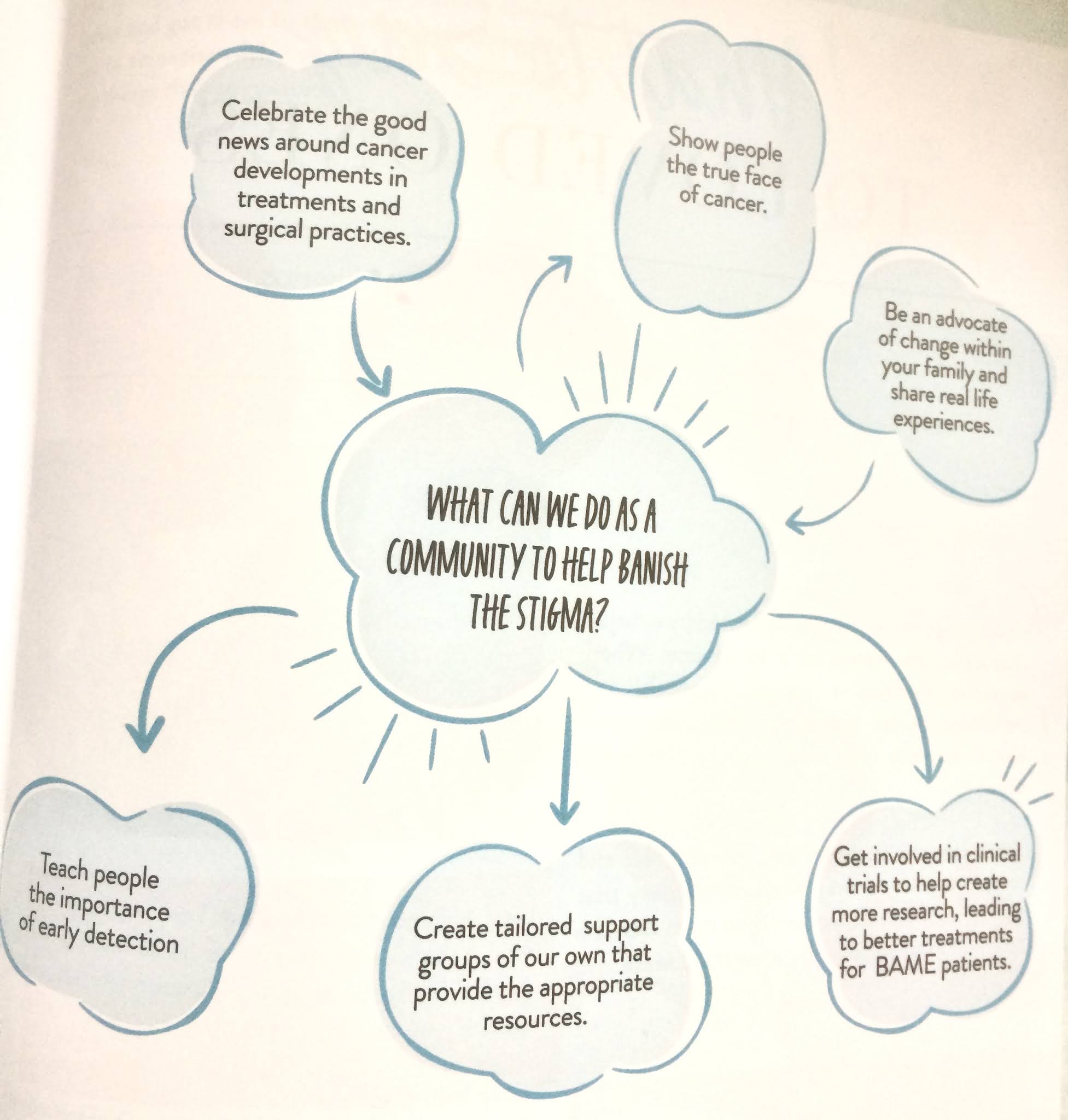
That leads me to one of the sections in the magazine that I particularly liked - looking at what we can do as a community to help banish stigma. 
 
The graphic opposite covers some of the ways which are already underway. I know we can all do more. This magazine is certainly a great start - could they be available in oncology waiting rooms? How else can we help reach out?
 
See more and order your copy of the magazine at: https://www.blackwomenrisinguk.org/
 
Notes
 
(i) See my blog with links to Black Women Rising podcasts, support groups and a film of Leanne talking at Trew Fields with the equally inspiring late Saima Thompson:  https://myunexpectedguide.blogspot.com/2020/07/yes-to-life-stands-in-solidarity-with.html

Saturday, 31 October 2020

Raising awareness; BBC’s ‘Prostrate’ radio series

In a recent blog I noted a series of funny, sensitive videos that tackles some of the silence around black America’s prostate cancer crisis (i). Well little did I know the BBC had a series of radio shows trying to do a bit of the same with Martin Jameson’s comedy drama.

Last month they released the series - starring Stephen Tompkinson and Gary Wilmot - the BBC describes them "as buddies grappling the country’s most common and least sexy male cancer”. What?!! The ‘least sexy male cancer’?? What a load of tosh! Are any cancers sexy? 

Anyhow it is great that this series is raising awareness - and particularly about the poorer survival rates for Black people. Although disappointing it doesn’t cover what else we can be doing to support our health and wellbeing. The episodes stay very clearly with conventional treatment despite the huge and growing evidence that lifestyle and complimentary can play a significant role in health. The show also appears slightly misleading at one point with mention of testosterone being the thing that helps prostate cancer grow. Well it is nothing like as simple as that - see my blog here looking at that issue a bit more (ii).

The website explains the title of the show; "Prostrate - because that's what everyone calls it and that's how it renders you - is a rebel yell of solidarity to every man (and supportive woman) living with the disease. The enemy is silence - the weapons are friendship and laughter”. Here’s the exchange between the two characters in episode one:

"Prostate not prostrate.”
“No its definitely prostrate.”
“Prostrate is when you are lying on the ground, helpless in complete supplication and submission.”
“And your point is?”
“Yeah, fair enough."

This is more of the description from the website:

"Tony – job going nowhere, marriage collapsed, son barely speaking to him - thinks life couldn’t get any worse. Until the nimble-fingered consultant tells him he has prostate cancer. Head spinning, Tony collides with Lenny’s car in the urology car park. Lenny has been in hand-to-gland combat with the disease for ten years but still lives life to the cantankerous max. Over five episodes, Lenny drags Tony out of the slough of despondency. Together they kick Tony's cancer into touch, and his life into vibrant new shape. 

"47,000 men are diagnosed every year, with UK deaths from prostate cancer now exceeding those from breast cancer. Writer Martin Jameson was diagnosed in 2013 and endured lengthy treatment in 2014, despite which he discovered a well of humour and life-affirming camaraderie with other prostate veterans whose experiences get to the nub of what it is to be a middle-aged man". 

Friday, 25 September 2020

Daddy’s Boys – a play tackling prostate cancer disparity in African-American men

I recently came across a series of funny, sensitive videos that tackles some of the silence around black America’s prostate cancer crisis - a situation not dissimilar to the UK. 

I’ve covered a bit here with my film of two wonderful activists about raising awareness and the local Prostate group in Gloucester - I also know the Black community in Gloucester have done some great awareness raising work. One in Four Black Men will get Prostate Cancer. For the rest of guys the stats are one in eight will get prostate cancer. You can see more about the reasons why this is so important in my blog about Yes to Life standing in solidarity with Black Lives Matters.

The Prostate Health Education Network (PHEN) worked with GDavis Productions to produce Daddy’s Boys. The story is about Jessie, a father of three living with a prostate cancer diagnosis. The PHEN motto is: “Knowledge is the best defense against prostate cancer.” Hence the series has lots of good info as well as challenging the taboos and silence. 
 
Apparently half the audiences are someone with prostate cancer or a family member - and they say they are also hoping this will educate women as they often have some influence over the men in their lives. Certainly the dramas will aid communication and enable folk to better support people - just knowing you can talk means people feel less alone - and plays/drama/creativity is such a great way to raise awareness.

See first two episodes at: https://www.daddysboys.net/tickets and they are hoping to tour again next year - sadly I guess they won’t come here but maybe there is a UK project that is similar?

Update 30/10/20: Here's some interesting new research which is better news - 'Black Men Have Better Outcomes From Radiation-Based Tx for High-Risk PCa': https://www.oncologynurseadvisor.com/home/cancer-types/prostate-cancer/racial-differences-radiotherapy-prostate-cancer-recurrence-metastasis/


Friday, 17 July 2020

Yes to Life Stands in Solidarity with Black Lives Matter

This blog post is a copy of my blog for Yes to Life (see here) - it is part of our journey to understand what we need to do at Yes to Life. We welcome thoughts from others, in terms of actions but also already have a number of actions in place. You can also see blog last year re stall we had in Gloucester to raise awareness. I also wanted to honour again Saima and her work; she will be so missed by so many.


My photo from Trew Fields last year: Saima and Leanne
The outrage following George Floyd’s death and the disproportionate impact of COVID-19 on Black, Asian and Ethnic Minorities (BAME) communities (i)(i) are powerful reminders of how much action is still needed in terms of racism and inequality. This is not a new issue. It has been staring at us in plain view for decades. But sadly recent events are a loud and much needed wake up call to us all. The message is clear: racism is experienced daily, from what some have described as ‘casual’, to much more serious incidents.  

It is easy to make statements about how awful racism is but it’s how we behave every day that really counts. How can I be a better ally? What do I do every day that can unwittingly perpetuate racism and discourages an environment of equality that welcomes all? How can we be allies in tackling racism in our communities? How can Yes to Life better serve black and other ethnic minority communities?

We know the experience of cancer is not the same for everyone. Black people have greater obstacles to cancer prevention, treatment, clinical trial participation (ii) and many other challenges. BAME cancer survivors die of cancer at higher rates than other groups (iii). This is unacceptable. 

Prostate and Breast cancer – two examples


Cotswolds Prostate Cancer Support Group, Jamaica Independence Day, Gloucester Aug 2019
Prostate cancer: 1 in 4 black men will get prostate cancer in their lifetime whereas national figures show a 1 in 8 chance of white men getting prostate cancer (iv). It has been hypothesised that the disease was biologically more aggressive in black men. However a large new US study has found that with equal care, African American and white men have the same prostate cancer survival outcomes (v). This doesn’t mean there are not biological differences, but it does mean we should not allow such differences to distract us from the fact that there is much work to do in terms of access to care.

Breast cancer: Black women are more likely than white women to die of breast cancer. We don’t know all the reasons for this difference, but biology does play a role. Black women tend to have more aggressive forms of breast cancer (vi), and those under 35 are twice as likely (vii) as white women of the same age to get breast cancer. The biggest impacts are again around access to care (viii).

Role of racism?

The reasons why some groups in society are hit harder than others are complex and relate to structural and socio-economic inequalities. In recent years we have seen some slight improvement in the racial disparities (ix), but the gap is still there and more research is needed to understand the factors involved. It is clear that without more understanding and data on cancer and ethnicity the experiences of the cancer journey will continue to be worse for people in BAME communities (x).

It was shocking to discover that there is so very little research looking at racism and cancer. Indeed the term ‘racism’ is rarely used in medical literature, and all too often  we see the differences in cancer survival rates – as in the case of prostate and breast cancers – explained away by implying that it is mainly due to genetic differences between races.
We don’t like to think that racism or discrimination plays a part in health outcomes, but as Marmot and Wilkinson concluded in 2005, an “adequate understanding of racism is fundamental to an understanding of ethnic inequalities in health” (xi). Some studies directly associate discrimination with such racial disparities in cancer survival rates (xii). There are also studies, such as one in 2016, which found that many medical students were approaching their patients with an underlying and unconscious bias that influenced how, for example, they measured and distributed pain relief (xiii). 

Our health system is an institutionally racist system. A deeply worrying NHS England Report earlier this year shows that BAME staff are suffering from increasing levels of bullying, harassment, and abuse (xiv). Prof Donna Kinnair, writing on racism in the NHS in The Guardian earlier this month, said: ‘In every community, BAME patients suffer the most’ (xv).

Cancer stigmatised in some communities

Leanne Pero, quoted in ‘Glamour’, shares how cancer is stigmatised in the black community (xvi); “There’s a lot of shame. You keep it within your family, you don’t talk about it. Black women have been told cancer ‘isn’t a black disease’ or that it’s karma or a curse for something we’ve done in the past. The worst thing is lots of women have been told not to get chemotherapy or life-saving drugs, because it’s ungodly…I’ve been presented with stories from women who had been banished from family events so as not to upset others. People were worried about catching it from them. One of the women was even told ‘don’t worry, I won’t tell anyone,’ when she told her family about her diagnosis. It’s seen as something embarrassing and shameful.”


Screenshot from Trew Fields video
Leanne joined Saima Thompson at last year’s Trew Fields cancer awareness festival (see photo), to talk about such cultural factors (see great video here) (xvii). Saima sadly died on 27th June and this is a huge loss; she was such a determined, warm and inspiring trailblazer (xviii). Many, including myself, have been touched deeply by her enthusiasm, energy – and indeed the change she has been creating around BAME and cancer. 

Saima and Leanne have both been tireless in sharing how cultural myths around cancer are stopping people from getting checked if they feel something is not right, and how such views impact on health outcomes. You can see Saima Thompson’s blog and the many ways she worked to create awareness and change around cancer at: www.curryandcancer.com There is also the ‘BAME Cancer Support’ group on Facebook that she established.

There is more from Leanne Pero at www.leannepero.com and the Black Women (and Men) Rising project she helped establish with monthly online support groups and podcasts that she co-hosted with Saima (xiv).

Access to complementary approaches

Yes to Life is the UK’s integrative cancer care charity (xv). Integrative Medicine is the judicious combining of conventional treatments such as chemotherapy, radiotherapy and surgery, with lifestyle and complementary therapies, to broaden patient choice, increase patient engagement, improve quality of life and extend survival. It’s a ‘best of both worlds’ scenario that has its roots in the patient perspective. Yet similarly to other challenges around access to good health care, studies have found that black people are also less likely to use complementary medicine than white people (xvi). What can be done to improve access for all?

Taking action

At Yes to Life we stand against those who perpetuate racism and violence, and stand in solidarity with those demanding equality. We must speak out against racism and be actively supportive of anti-racist movements, especially those of us in positions of influence. Racism is so deeply entrenched that visible actions are needed. 

As a charity we will seek to work with others to make sure that cancer services and care are available to all, equally. We all need to look at what we do, to catch our unwitting racism and do something about it. We know we can improve the ways in which we engage with the black community. To be silent on this issue is to be complicit. 

Our thoughts are with Saima’s family and friends.

Find out more at: www.wigwam.org.uk

Notes

(i) Covid-19 and racism: https://www.theguardian.com/society/2020/apr/29/extra-18000-cancer-patients-in-england-could-die-in-next-year-studyand https://www.theguardian.com/world/2020/jun/05/uk-equality-watchdog-to-launch-inquiry-into-entrenched-racism
(i) Update 28/07/20: I note that there are problems with using the term BAME: https://www.bbc.co.uk/news/uk-53194376
(ii) Black Patients Miss Out On Promising Cancer Drugs: https://www.propublica.org/article/black-patients-miss-out-on-promising-cancer-drugs
(iii) ’The Rich Picture, People with Cancer from BME Groups’ Macillan report: https://www.macmillan.org.uk/_images/bme-groups_tcm9-282778.pdf
(iv) https://prostatecanceruk.org/get-involved/black-men-and-prostate-cancer and see research (2008-10): https://pubmed.ncbi.nlm.nih.gov/26224061/
(v) https://acsjournals.onlinelibrary.wiley.com/doi/abs/10.1002/cncr.32666
(vi) A Population-Based Study From the California Cancer Registry: https://pubmed.ncbi.nlm.nih.gov/17387718/
(vii) Racial/ethnic Variation in Clinical Presentation, Treatment, and Survival Among Breast Cancer Patients Under Age 35: https://pubmed.ncbi.nlm.nih.gov/12491515/
(viii) Breast Cancer Disparities at home and abroad: https://www.ncbi.nlm.nih.gov/pmc/articles/PMC5499686/#R65
(ix) Structural Racism & Breast Cancer Deaths Among Black Women in Chicago:https://hcfdn.org/structural-racism-breast-cancer-deaths-among-black-women-in-chicago/ and Racial Discrimination and Breast Cancer Incidence in US Black Women: The Black Women’s Health Study: https://academic.oup.com/aje/article/166/1/46/135692
(x) No One Overlooked: Experiences of BME people affected by cancer’ Macmillan report 2015: https://www.macmillan.org.uk/documents/aboutus/research/inclusionprojects/experiencesofbmepeople.pdf
(xi) The social determination of ethnic/racial inequalities in health (2005) Michael Marmot and Richard G. Wilkinson: https://www.oxfordscholarship.com/view/10.1093/acprof:oso/9780198565895.001.0001/acprof-9780198565895-chapter-12. 
(xii) Perceived Discrimination, Coping, and Quality of Life for African-American and Caucasian Persons with Cancer: https://www.ncbi.nlm.nih.gov/pmc/articles/PMC4819019/ and Impact of Perceived Racial Discrimination on Health Screening in Black Women: https://www.ncbi.nlm.nih.gov/pmc/articles/PMC3760200/
(xiii) Racial bias in pain assessment and treatment recommendations, and false beliefs about biological differences between blacks and whites; https://www.ncbi.nlm.nih.gov/pmc/articles/PMC4843483/
(xiv) 2019 report: https://www.england.nhs.uk/wp-content/uploads/2020/01/wres-2019-data-report.pdf
(xv) Prof Donna Kinnair on racism in the NHS: ‘In every community, BAME patients suffer the most’: https://www.theguardian.com/world/2020/jun/10/donna-kinnair-racism-nhs-if-you-arent-white-your-illness-isnt-taken-as-seriously
(xvi) Black women with cancer are treated differently to white women. Fact. Let’s change that…”Our voices need to be heard”: https://www.glamourmagazine.co.uk/article/black-women-cancer
(xvii) Video of Saima and Leanne at Trew Filelds Festival 2019:https://vimeo.com/user104087161
(xviii) Pioneering Restaurateur Saima Thompson Used Her Cooking to Create Space for Others – Remembering the co-founder of Masala Wala Cafe, who used her platform to build visibility and  ownership for women in the Pakistani community: https://london.eater.com/2020/7/1/21309839/saima-thompson-masala-wala-cafe-obituary-curry-cancer
(xiv) And podcasts at: https://podcasts.google.com/?feed=aHR0cHM6Ly9hbmNob3IuZm0vcy8xZGQ5ZWM2Yy9wb2RjYXN0L3Jzcw&ved=2ahUKEwjSrua9o-jpAhUCNxoKHcsEAKcQ4aUDegQIARAC&hl=en-GB
(xv) https://yestolife.org.uk/
(xvi) Racial and Ethnic Profiles of Complementary and Alternative Medicine Use Among Young Adults in the United States: Findings From the National Longitudinal Study of Adolescent Health: https://www.ncbi.nlm.nih.gov/pmc/articles/PMC3711674/ and Racial/Ethnic Differences in the Use of Complementary and Alternative Medicine in US Adults With Moderate Mental Distress: Results From the 2012 National Health Interview Survey: https://journals.sagepub.com/doi/full/10.1177/2150131916671229

Friday, 11 October 2019

One in Four Black Men will get Prostate Cancer

That headline is shocking - and we still don't know why that is the case. For the rest of guys the stats are one in eight will get prostate cancer. It was great to see our Cotswolds Prostate Cancer Support Group getting out to talk to folk at the Jamaica Independence Day celebrations in August.  They were there raising awareness and encouraging folk to have their PSA checked.  You can read more about the national campaign here.

Update 28/01/20: a new study shows that African American men have similar survival rates to white counterparts if they have equal access to healthcare. This is disturbing to find that survival rates may have so much to do with access to care - see here (i).

Update 19/10/20: Study seeks to find out why black men develop prostate cancer at twice the rate of other men: https://www.icr.ac.uk/news-archive/study-seeks-to-find-out-why-black-men-develop-prostate-cancer-at-twice-the-rate-of-other-men

I've got two of my films below, the first with the Support Group at the Jamaica Day celebrations saying a bit about their group and the second is a couple of clips from the amazing Trew Fields Festival and a talk about Cultural Challenges for Ethnic Minorities. The talk was hugely challenging as there is so much work that needs to be done to increase understanding. I applaud Saima Thompson and Leanne Pero for encouraging and campaigning for that understanding. You can see more from Saima Thompson at www.curryandcancer.com and more from Leanne Pero at www.leannepero.com There is also a 'BAME Cancer Support' group on Facebook. Lastly there is a report free to download from Malecare here

Update 14/06/20: Just uploaded is the whole talk by Leanne Pero & Saima Thompson on  'Cancer: cultural challenges for ethnic minorities': https://vimeo.com/372627081


Notes


New interpretation of cancer

I've written here before about  Mark Lintern's Cell Suppression Theory of Cancer - in his latest blog he sets out the case for a cle...