Sunday, 31 January 2021

Gluten Free Fermented Buckwheat Bread

This is such a straight-forward loaf in many ways - and I love that buckwheat flavour - especially when the bread is toasted - but know for some it doesn’t work. 

We got this recipe a couple of years ago and have been making it ever since then. However only recently I’ve found a similar version online - it looks like it might have come from the Breadtopians website - they call themselves 'pragmatic bread freaks’ and say they 'launched in 2006 with a mission of ensuring that baking perfect bread at home is available to everyone’ (i). Their website is well worth a look.

On this bread they write: "In making this bread, I worked from a recipe I found on a blog called Nutriplanet, and that author credits another blog called Conscious Catering. One of my modifications was to add flax and pumpkin seeds for flavor, texture, and visual appeal. Of course, you can use you whatever seeds you want: chia, hemp, sunflower, sesame, poppy or none at all."

Buckwheat is a seed and a great source of protein and Breadtopia link to research from Uppsala University in Sweden linking buckwheat consumption to lower levels of bad cholesterol and better blood sugar management in diabetes (ii). Well controlling blood sugar levels mean it will also be good for lowering risks of cancer and heart disease.


Gluten Free Fermented Buckwheat Bread

Preparation time is around 30 minutes and cook time is around an hour and 20 minutes although we always seem to leave it a bit longer.

Ingredients

• 450 g buckwheat groats not toasted (2 1/2 cups) 
• 3 cups of water for soaking the groats
• 330 g water for the batter (1 1/3 cups) 
• Half tsp seasalt
• 1/3 cup pumpkin seeds 
• 3 Tbsp of toasted flax seeds 
• Several handfuls of pumpkin seeds and toasted flax seeds for decorating the top of loaf

Instructions - taken from the Breadtopia website.

• Soak the buckwheat groats in water for 5-6 hours.
• Drain the groats in a colander but do not rinse. The run-off will be very mucilaginous.
• Blend the groats and new water in a blender or food processor. You may need to do this in two parts if you use a food processor, so as to not go over the top of the central blade tube and have leakage. 
• Pour into a glass bowl or large measuring Pyrex, and cover with a towel. This will be about 5 cups of batter.
• Set aside for approximately 24 hrs at 67-70 F. Fermentation time is significantly shorter at warmer house temps or in the oven with the light on. Batter expansion is roughly from 5 to 6.5 cups. Do not mix the batter until the fermentation is finished or the batter will deflate, and it will be hard to calculate growth.

• At the end of the fermentation, gently mix in the salt and any seeds you wish to add. 
• Pour the batter into the parchment paper-lined loaf pan, and decorate the top of the loaf.
• Let the batter rise for another 30 minutes to an hour in your lit oven.
• Preheat the oven to 350 F with pan in the oven.
• Bake for approximately 80 minutes (less for a long narrow pan) or until the inside temp is about 200 F. 
• Remove from the oven and lift the parchment paper out of pan onto a cooling rack. Peel it off and let the loaf cool for at least 30 minutes before slicing.

Enjoy!

Update 5.3.23: interesting article looking at buckwheat: https://foodrevolution.org/blog/is-buckwheat-healthy/


Notes

Saturday, 30 January 2021

Sleep potion - the Nutmeg Night Time Milk

A couple of favourites in terms of sleepy drinks are the wonderful Pukka Night time tea and Clippers Sleep Easy Infusion. But what of all those recipes online for getting a good night sleep? There are so many potions and suggestions. I’m fortunate to get good sleep most nights, but my partner has less good nights so we have been on the look out to try a number of these online suggestions. Our favorites seem to come from the Ayurvedic tradition - often backed by many hundreds of years of use.

One Ayurvedic recipe we liked was an Ojas Tonic made with milk, chopped dates, almonds and coconut plus cardamon and ghee. However I’m more cautious since my diagnosis about dairy and dried fruits so didn’t continue with this one.

I also for a long while made the ‘Golden Milk’ made with a non-dairy milk, tumeric and cinnamon with a pinch of black pepper and shaving of coconut oil. Turmeric is fat-soluble, meaning that without a little bit of fat the curcumin and other wonders will not be absorbed into your blood stream as well - hence the coconut oil - or alternatively using a full fat milk. The black pepper is also key as piperine is said to improve the bioavailability. 

Sleep is key and in Ayurveda it is considered to be as important as nutrition in terms of maintaining health and wellbeing. Sleep was one of the ‘basics’ covered by Ayurvedic consultant Dr Sam Watts (i) - but also covered when he discussed our circadian rhythms (ii) - amazingly “when” we eat is turning out to be just as important as “what” we eat. 

Sleep, not surprisingly, features as a key factor in many books about cancer - for example is one of six key factors in Dr Lorenzo Cohen and Alison Jeffries book “Anti-Cancer Living”.  They see that getting sleep right is a crucial part of a healing journey. I can certainly recommend that book.

Anyway it was Sam that put us onto the Nutmeg Night Time Milk - and also asked all to pass it onto others - so here it is - possibly with a slight adaptation as I can’t find my original notes - online there are some other slight variations of this but guess you can adapt to your own taste. It has now become a firm favourite and we have it three or four times a week.


Nutmeg Night time Milk


Cup of milk - your favourite non-dairy
Pinch of black pepper
Half a teaspoon tumeric powder
Half a teaspoon cinnamon
Teaspoon nutmeg
Small pinch of ginger
Large pinch of ground cardamon
Half teaspoon of ghee or coconut oil

Whisk ingredients then bring to boil then on low heat simmer for 2-3 minutes to extract the medicinal qualities. Add honey (or not) to taste. One cup recommended between 7 and 8 in the evening so can start working its magic for sleep at 10.


Nutmeg is one of the clinically proven herbal sedatives - it is proven to induce better quality and quantity of sleep. It is also worth a mention that the National Cancer Institute of Maryland demonstrated chemopreventive properties of nutmeg extract. It is found to induce cell death in leukemia cells (iii). However use with care as it can in excess cause a high and not so good effects (iv)!  

In terms of some of the other ingredients of this ‘potion’, they have also been billed as having possible anti-cancer effects. Tumeric I’ve noted earlier (v) has anti-inflammatory properties and one of the compounds of tumeric, curcumin, is considered to selectively starve tumor cells to death (vi). Michael Greger's book 'How Not To Die' argues everyone should be taking daily a quarter of a teaspoon of tumeric, powdered or root - well actually those with gallbladder problems and some others should avoid. As always check out whether this is right for you or not.

Ginger has also had some research indicating it "can reduce the size of cancer tumours, and causes apoptosis of both normal cancer cells and cancer stem cells”(vii). Similarly cinnamon has research showing its impact on cancer (viii). So not only can this wonderful tasting drink help sleep - and it does with us - but also it seems to have anti-cancer properties as well. Enjoy!

Lastly if you are interested in an Ayurvedic approach to health then I can recommend joining Sam’s Facebook page for more Ayurvedic wisdom  at: https://www.facebook.com/mindbodymedical

Thursday, 17 December 2020

Wigwam Cancer Support Groups and Forums

The wonderful Ticking off Breast Cancer blog posted this blog of mine a month or so ago - I've copied it below. The Breast Cancer blog is by Sara Liyanage who published her story in a book with the same name as her blog. A big thank you to Sara - before sharing the blog below about Wigwam I wanted to add my preferred definition of Integrative Medicine is that it 'combines the best of conventional, lifestyle and complementary approaches to improve health and wellbeing'. I guess the word 'alternative' sometimes conjures up less well researched approaches - see my discussion on that here. Anyhow now to my blog:

This is a guest blog from Philip Booth, the coordinator of Wigwam – part of the Yes to Life cancer support community. Wigwam is a cancer support group with a difference. It is a community of people living with cancer coming together to explore and share information and experiences with the aim of empowering themselves to gain control over their lives. Wigwam is a place for people to meet locally or online. Wigwam is a place of safety and care, which is flexible and supportive, to meet others sharing similar issues and to learn about Integrative Medicine. (For those of you who don’t know what integrative medicine is, it is a form of medical therapy that combines practices and treatments from alternative medicine (such as exercise and nutrition) with conventional medicine (such as chemotherapy and radiotherapy).

Overwhelmed. Terrified. Bewildered. Just some of the emotions I felt following my prostate cancer diagnosis over three years ago. I didn’t know what to do. This was compounded by a number of different treatment options. What was the best way forward?

Just after the diagnosis, I asked my oncologist about diet and exercise. I was told that I was pretty fit and to keep doing what I was doing. I knew, that while this advice was well-meaning, it did not fit with what I knew; there is so much we can all do to improve our health and wellbeing.

So I set about learning. To my surprise I came across lots of studies that showed significant benefits. Exercise got lots of mentions – no doubt blog readers here will know of studies like the one in 2007 of 1,490 women with early stage breast cancer. They found that those who exercised, like walking for 30 minutes each day and ate more than five servings of vegetables and fruit per day, had a whopping half the recurrence rate after nine years compared to those who didn’t (i).

Taking an integrative approach

It was some months after learning about exercise that I came across Yes to Life – and discovered they are the UK’s leading charity seeking to improve access for people with cancer to Integrative Medicine. They provide support, information and financial assistance to those with cancer seeking to pursue approaches that are currently only available as private healthcare.

You may well have come across them recently, as they have just put on two great online events with forty plus global experts; the ‘Your Life and Cancer’ weekends (ii) – and we were delighted to have had Ticking off Breast Cancer as one of the many supporters. It was a wonderful coming together and sharing of evidence-informed healthcare to achieve optimal health and wellbeing.

I have so appreciated that the charity is all about combining the best of conventional, lifestyle and complementary approaches. This made so much sense to me and I’ve been on a learning path ever since that has given me a much greater understanding of my cancer and what is possible.  Indeed, the more I have read, the more the UK’s focus almost exclusively on surgery, radiotherapy and chemo seems such huge missed opportunity.

Around the world other countries have embraced the research into cancer that goes beyond our conventional approach. In China, for example, if you aren’t taking herbs as part of your cancer treatment then that is seen as negligent, while in parts of Europe, mistletoe injections and hyperthermia are recognised by many medical doctors.

So where can we talk and learn safely?

There are not many places where it is possible to discuss other options. When I spoke to Yes to Life nearly three years ago, I found out they had plans for developing ‘Wigwam’ cancer support groups that focused on an integrative approach.

Within a few weeks, three of us came together in Stroud. We’ve not looked back, and ten of us meet each month to share where we are at and explore different approaches together. It is not about giving advice, but has been a wonderful, confidential place of support to explore challenges, opportunities and share information.

Why call it Wigwam?

Well the idea came from Richard Mayon-White, who had cancer in 2016, he said “a wigwam provides shelter that is flexible, with an informal style and not fixed in any one place. The way that the poles of a wigwam lean inwards to support each other illustrates how a successful group can offer care and help to its members”.

One Wigwam member said they hadn’t realised how lonely they had been on their cancer journey, while another said; “It was such a relief to find an open and supportive group, totally on the same wavelength when it comes to the challenges faced by those of us looking for a more proactive and personalised approach to healing ourselves”.

Eighteen months on and I joined the Yes to Life team to help the charity establish more groups. Our first online Wigwam group has just been meeting and growing. Feedback is very positive and we are planning more. If you are interested you can complete the ‘Get Involved’ page on our website and we will be in touch.

Free Forums and Webinars

In addition to the support groups we also now host live expert-led online forums every other week, the podcasts of which, are then available online. Topics coming up include sugar, toxins, dance, appetite and an integrative approach. We also have a weekly mindfulness drop in and more planned. See more at: https://www.wigwam.org.uk/events-and-sessions

Philip Booth – Wigwam Coordinator for Yes to Life

Philip has a background in Social Work, managing care services, local politics as a councillor and for the last eight years has worked for a charity helping residents in Gloucestershire build more welcoming communities. His own journey with prostate cancer has led to a passion for helping people come together to support each other in more proactive, personalised approaches to health and wellbeing.

For more information please take a look at the websites of Wigwam and Yes to Life . In addition, Wigwam is on Facebook: wigwamsupport and Philip blogs occasionally about his prostate cancer journey.

Notes

(i) Greater Survival After Breast Cancer in Physically Active Women With High Vegetable-Fruit Intake Regardless of Obesity: http://ascopubs.org/doi/10.1200/JCO.2006.08.6819

(ii) https://www.yourlifeandcancer.com

Please note that I, as Ticking Off Breast Cancer, do not accept responsibility for the content of the guest blogs. The information and content provided in all guest blogs is intended for information and educational purposes only and is not intended to substitute for professional medical advice. Please seek professional advice or speak to your medical team if you have any questions about the issues raised in this guest blog.

Saturday, 12 December 2020

True self-care

We often come to self-care when we are exhausted or get a diagnosis - and certainly it has been that way for me at times in my life. A while back I had thought to write a blog building on what I've written before about self care - see here blog re getting the basics right - the blog I imagined would have mentioned all those things that can help some folks like cold showers, fasting, saunas, good food and so much more. It was going to be about doing some of the things we wouldn't choose to do, may not be easy to do - and how alcohol, procrastination and other stuff can get in the way.

Then I came across this quote by writer and poet, Brianna Wiest; "True self-care is not salt baths and chocolate cake, it is making the choice to build a life you don’t need to regularly escape from.”

And that got me thinking.....no doubt Covid-19 has helped...when holidays, visits to friends and more are not an option...I can't escape in the ways that are familiar.....this has perhaps been a gift (and a challenge) to help me think about what I need and want to do....which goals are key and which ones to drop.

Cold shower
This has been compounded some weeks ago when I faced voluntary redundancy in one of the two charities for whom I work....I've loved this job and been there over eight years. Sadly the new jobs they offered, subject to interviews, did not make my heart sing. I agonised for weeks before saying no to the new jobs. I am fortunate to have other options but all this raises great questions about how we look after ourselves and purpose.

Indeed having strong reasons to live is one of the key factors that Kelly Turners' research identified as being key in radical remissions. So how can we become the person we know we want and are meant to be? Where does self care fit with all of this? Oh my perhaps it is easier to go and watch a film!

As Brianna says: "someone who knows that salt baths and chocolate cake are ways to enjoy life – not escape from it".

Friday, 11 December 2020

Luzita Hill dies; ‘patients not criminals’ #cannabis campaigner

I was so very sorry to hear that Luzita Hill died on Saturday. It has been 8 years since her breast cancer diagnosis and she was told she wouldn’t live beyond 3rd June 2017. I met her at Trew Fields in 2018 and 2019 and her wonderful energy totally inspired me - she shared with me some of her campaigning work for the use of cannabis in cancer treatment. Her warmth and passion shone through and I loved her down to earth, no-nonsense approach.

Luzita has been an extraordinary, fearless campaigner who has been at the forefront of campaigns for Medical Cannabis. She chose the title of #cancercriminal because she was forced to break the law to treat her cancer. A lovely post on her Facebook page said: "She fought the prejudice, fear and misinformation. Squarely putting a mirror up to the hypocrisy of politicians who make money from growing it commercially while at the same time denying it to their own people so desperately in need of its medicine. When she stood up to speak, people listened, they dare not because she wasn’t going to back down". 

Luzita converted her skeptical integrative health team, including GP, to buying into her belief that cannabis has been the key to her on-going vibrancy. Even last month she was appearing in videos as a cannabis patient advocate talking about treating symptoms: https://youtu.be/Yznfn_8qZV8

Indeed once you start looking into this whole area there are a host of articles about cannabis and its use in treatment of cancer and symptom management (i) - including lots in PubMed. More research is needed as we still need to learn more about its effectiveness, dose, side-effects and more but there is more than enough evidence out there to make it readily available. This blog post is not for a discussion on that now - am sure I will do a post in the future. 

As part of her campaigning, Luzita spoke in Parliament with the United Patients Alliance, a Not For Profit organisation run by chronically ill patient volunteers, talking about cannabis. See her speech here: https://youtu.be/Vz6kUEqhb_0

Luzita fully supported the campaign for the trial launched in 2018 to target 20,000 patients with cannabis. Indeed she was signed up to participate and I’m told she became legal a few weeks before dying with her first cannabis description for pain relief. However disappointingly the trial has got off to a rocky start with only 12 prescriptions being made in the first year (ii) and few, if any after that up to this summer(iii). It seems despite growing evidence of how supportive medical cannabis can be, there is still a reluctance to prescribe in the NHS. Luzita's work is changing that - many of us need to continue her work.

Luzita also lived to see the introduction of the Cancard on 30th November; patients with a multitude of health conditions will have the right to apply for Cancard (iv). Journalist Roland Sebestyen, writes: "The card, which is backed by police commissioners, communicates to police officers that a person should not be arrested for consuming self-sourced ‘illegal’ cannabis as a medicine. Up to 1.1 million people could be eligible for a Cancard by 2021, removing the fear of arrest and prosecution for possession. All patients with a health condition, that is currently being privately prescribed for at a high cost, will be eligible for the card”. 
 
In terms of Cancer and this card, the conditions that are included are: "Anxiety, Chemotherapy-induced nausea, Cancer-related appetite loss, Depression, Palliative care." I’ve heard very little about this card so would love to hear how this is working?
 
Here’s another film with Luzita sharing how she got interested in cannabis: https://youtu.be/zoAbTPISpt0

Thoughts with her husband, Terry and her family and close friends. Thank you Luzita for all you did - know we will continue the work.
 
Notes
 
See also Tedx talk and one story about its use with pain: https://youtu.be/jyAGlb8PMRc 

Saturday, 21 November 2020

European Prostate Cancer Awareness Day calls for action; what did I learn?


The European Prostate Cancer Awareness Day (EPAD) aims to raise awareness and enhance knowledge of prostate cancer. Oncology specialists, patient advocates, politicians and policymakers gathered for EPAD20 online and in Brussels on 17 November 2020. I missed the live event but have been catching up with their videos/presentations. Some of the findings that I found interesting are below - scribbled notes as I tuned into these talks - big thanks to EPAD for letting people living with cancer join.


Things have improved significantly since PSA was introduced
 
However 1 in 7 men in Europe will develop prostate cancer before they are 85.  Figures show in 2018 107,000 died from prostate cancer in Europe. 
 
Prostate cancer was said not to be a killing disease: “You will die with, not from prostate cancer”. Yet this is plainly not so true. It has been suggested that PSA testing was overused and led to over diagnosis and over treatment. Instead people with early diagnosis should have been offered Active Surveillance. This over diagnosis and treatment led to the anti-PSA propaganda - yes it is not a great measure but it has still helped with early detection that has led to less mortality. 
 
When there was less PSA testing it appears prostate cancer deaths increased. Prof. Hein Van Poppel in setting the scene to the conference challenged that much less was being done for prostate cancer than other cancers and asked why are we are letting this happen.

Prof. Monique J Roobol in her talk started with a quote from 1993 in the BMJ wrote: "About 50-60% of all cases of prostate cancer in the European Community present with obvious metastases or are locally too advanced for potentially curative management. Of those cancers that seem to be limited to the prostate clinically, 25-35% will have lymph node metastases. Of the remainder, another 25-35% will be too advanced for curative treatment and will turn out to be unresectable if surgery is attempted.” 
 
She went on to share the results of clinical trails saying that things "will hardly be different in 2021 and onwards if we do not act.”  She concluded:
  • Data from pre-PSA era show that PCa is a disease often related to a lot of suffering over a considerable period
  • 2 out of 3 men diagnosed with PCa died of their disease
We now know that: 
  • Organized screening with the use of the PSA test reduces suffering and dying from PCa
  • Potential harms ( unnecessary testing /over diagnosis and over treatment) can be largely avoided
Indeed the talks repeatedly concluded that early detection should be offered and can save lives. Are we doing enough? It seems not at the moment. As the Prof. Hein Van Poppel said in answer to a question, mortality is increasing in the UK due to the "propaganda against PSA testing" and GPs need to know that and we need to act. He goes onto "say early detection is likely to be the way out of it”.

When asked about prevention Monique J Roobol said it was research was still underway and that it was hard to know what can be done to prevent prostate cancer but we are aware of risk factors - mainly related to diet - particularly red meat being not good and tomatoes being good.


EUPROMS study - some surprises re quality of life after treatment

Key findings from nearly 3,000 responses in this study were highlighted by Mr. André Deschamps in his talk include:

Prostate Cancer is not an old mans disease; average age at diagnosis is 64. Nearly 30% are diagnosed before 60 and 76% before 70. 
 
Anxious and depressed; 42% of men who have been treated for prostate cancer are anxious or depressed to some extent at the time of the survey - with 15% extremely, severely or moderately impacted.

Sexual function;
there was slightly more impact with radiotherapy than radical prostatectomy - both treatments impacted significantly but this research flies contrary previous thoughts that prostatectomy had worse outcomes re sexual function. Of huge concern was the overall some 28% have a big problem and 22% a moderate problem ie 50%!

Continence: prostatectomy was worse than radiotherapy and its seems after treatment (I think they mean any of the standard treatments) a whopping 37% of men use one or more incontinence pads every day.

The conclusion is that early detection is key and that active surveillance should be considered as the first treatment in order to ensure the best quality of life.


The Awareness Day also heard from November and their campaigns to raise awareness about early detection - see more re UK branch at: https://uk.movember.com/

Sunday, 1 November 2020

Black Women Rising: new magazine

I recently got my copy of the wonderful 'Black Women Rising’ magazine - another opportunity by teh inspiring Leanne Pero and the gang at Black Women Rising to empower women of colour as they navigate their cancer journeys. There are also plans already under way for Black Men Rising.

The mission at Black Women Rising is to educate, inspire and bring opportunities for women from the BAME community, to connect with one another and share their stories, without fear or shame. As their website says; “As well as..generic injustices, the unhelpful myths and taboos surrounding cancer within the BAME community had ultimately stopped people from speaking out about their ordeals, leading to a lack of awareness and education within BAME households around cancer, its signs and symptoms. This ultimately led to the devastating outcomes of late stage diagnoses and higher mortality rates in some cancers than their white counterparts.”

Check out their podcasts
Black Women Rising have support groups and podcasts which I have mentioned in a previous blog - see here (i). This magazine will be another way to reach out. It covers loads with a look at the project, many voices from folk living with cancer, signs and symptoms, what to say to loved ones, hair, beauty, sex, gratitude, menopause, LGBTQI, genetics and so much more.


Options can be overwhelming

The magazine touches on lifestyle with Toral Shah talking nutrition and a section on exercise with Jonelle Lewis - from an integrative health perspective there is lots more evidence that could have been included around other stuff we can do to build our health. However I see one of the biggest challenges being about how not to  overwhelm people with too much info. 
 
In the recent ‘Your Life and Cancer’ online event with 40 plus global experts it was more than clear how much evidence is out there. Some options cost loads while others are almost no cost. But how do you choose? And how do you find what is right for you? 

The magazine focusing on nutrition and exercise is clearly a great place to start. However as I noted in the previous blog (mentioned above) (i), complementary medicine like conventional treatment does also not seem to be able to serve the BAME community in terms of people living with cancer.

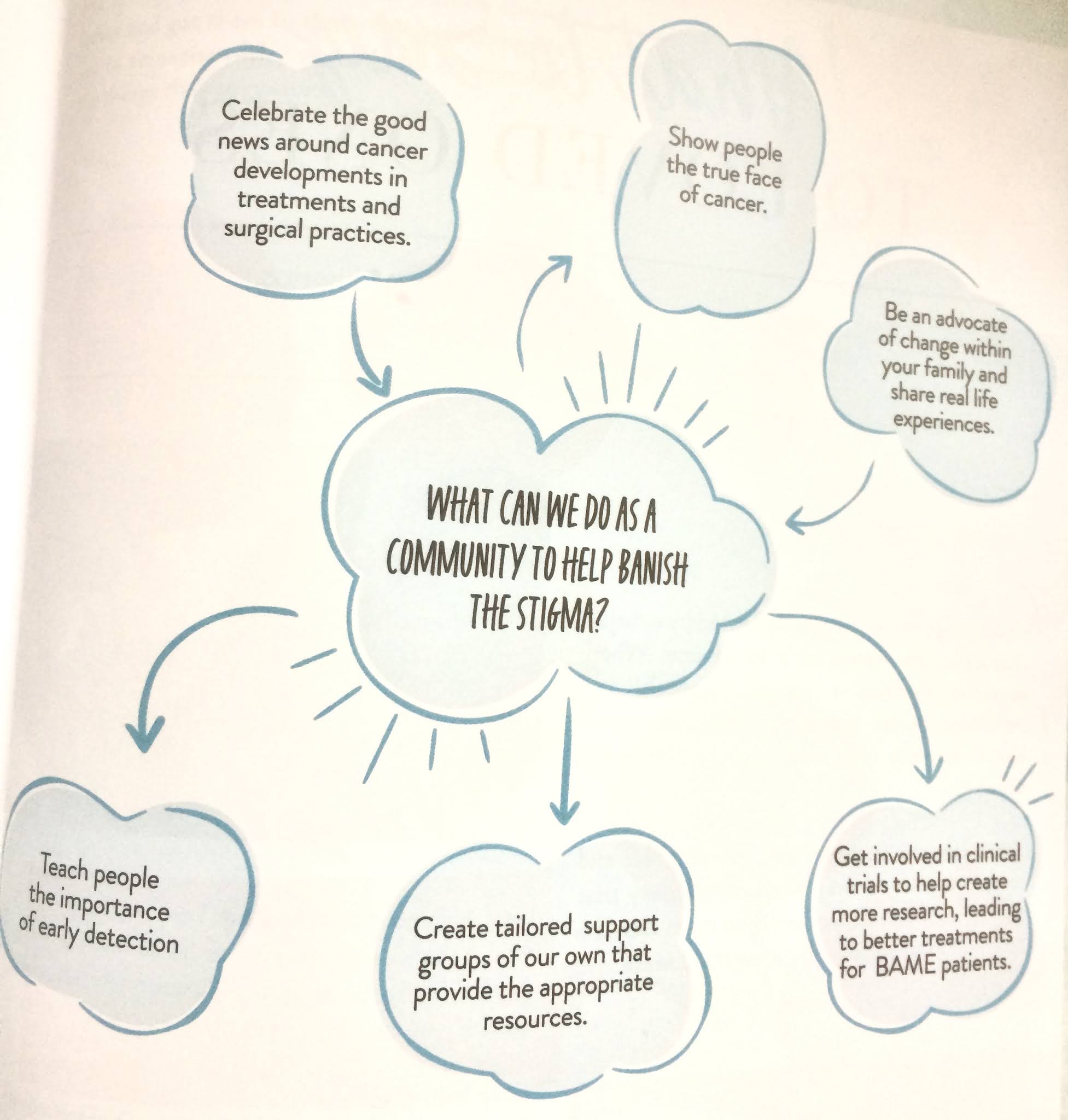
That leads me to one of the sections in the magazine that I particularly liked - looking at what we can do as a community to help banish stigma. 
 
The graphic opposite covers some of the ways which are already underway. I know we can all do more. This magazine is certainly a great start - could they be available in oncology waiting rooms? How else can we help reach out?
 
See more and order your copy of the magazine at: https://www.blackwomenrisinguk.org/
 
Notes
 
(i) See my blog with links to Black Women Rising podcasts, support groups and a film of Leanne talking at Trew Fields with the equally inspiring late Saima Thompson:  https://myunexpectedguide.blogspot.com/2020/07/yes-to-life-stands-in-solidarity-with.html

'Making skillful decisions at a glance'

'Making skillful decisions at a glance' is the title of a post by Cancer Choices. It is a useful start to anyone diagnosed with canc...