I just had a blog published on the Wigwam website looking at one of the most important areas that we need to pay attention to in terms of our healing; our social support networks. there really is some fascinating research out there - and of course I don’t miss the opportunity to share more about Wigwam Cancer Support Groups.
 See the full blog that I'm delighted to say has been widely retweeted and shared already. See it at (and now below): https://www.wigwam.org.uk/post/what-can-make-the-biggest-difference-to-our-healing
In this blog Philip Booth, Wigwam Coordinator, takes a look at what he considers to be one of the key areas we need to pay attention to in terms of our healing; our social support networks - and of course he doesn’t miss the opportunity to share more about Wigwam Cancer Support Groups.


What can make the biggest difference to our healing?
For the last nine years I’ve been working for a charity who were involved with building welcoming communities. It was a huge privilege to come alongside people to learn and help them imagine and create relationships and community even where folk were grappling with serious challenges. I came to understand that almost any issue, whether it be racism, climate change or the impact of austerity, could be significantly improved. Indeed, as Margaret (Meg) Wheatley famously said, “Whatever the problem, community is the answer”.
Now working for the charity ‘Yes to Life’ for a few hours a week I’ve joined others in helping build the Wigwam integrative cancer care community; setting up Wigwam Cancer Support Groups, Forums, Wellbeing Groups and more. Again, it has been a huge privilege to find so many incredibly committed, welcoming people dedicated to broadening our view of health to include not just conventional treatments but also lifestyle and complimentary approaches.
The more I understand about health the more it seems that ‘community’ is also a part of the answer to healing from cancer. The research backs this up; one of those key social determinants of health is our social support networks (i). Building more connected and welcoming neighbourhoods is part of the answer but that is a whole other blog! (ii).
In this post I wanted to look more on social support for those of us living with or beyond cancer - and why it is important.
What is social support?
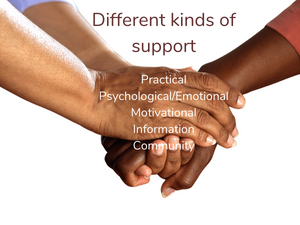

Support is not just about practical support like the friends that helped get me to radiotherapy or the meals members of our Wigwam Cancer Support group cooked for one of us facing a particularly gruelling treatment. Support is much more. It can also include;
Psychological or emotional support to listen to fears, share joys and challenges and perhaps help understand deep emotional issues.
Motivational support to help us make and stick to changes we want to make to heal and to remind us we are more than just a patient.
Informational support and help to discuss options.
Community support with those connections and sense of belonging but also the opportunities to help others.
Dr Lorenzo Cohen and Alison Jefferies in their excellent book, ‘AntiCancer Living’ (iii), describe social support as the “backbone on which all other lifestyle changes will either succeed or fail”. Support is indeed what helps us to make the healing changes we need - and a cancer diagnosis is the time to build on any existing support networks.
Having someone look after the children when you have a doctor’s appointment or Qi Gong session is important but it is often emotional support that is most needed. Research shows that when we are around loved ones (including pets), the feeling of being loved releases into our bloodstreams a host of healing hormones, including oxytocin, and makes us feel better emotionally but also enhances our immune system.
I know how incredibly supportive it felt when family and friends really listened and respected my plans for cancer treatments. Building our support network is an essential first step in our cancer journeys; it is key in sustaining and improving our lives. Those with strong social support live longer.
Study after study confirm this (v). For example, research in 2005 showed women with breast cancer with greater support outside their homes were 60% less likely to die from cancer a decade after their diagnosis (vi). Other studies show that if you are married, or partnered your outcomes are better but it is having the strong social support that is what matters most, not where it comes from - a spouse, several close friends and/or a wider network all play a part. So, don’t just rush out and get married to improve your life expectancy there are other ways to build your support network!
There is also evidence from the so-called ‘Blue Zones’ where there are the highest percentage of centenarians; in these areas it is strong community that has one of the biggest positive impacts on our health and longevity (vii).
‘Social support’ was unsurprisingly one of the nine factors that Kelly Turner identified in her research into ‘Radical Remissions’; it came out repeatedly as one of those keys to ‘unlock your pathway to dramatic healing’ (viii).
Sophie Sabbage, a Patron of ‘Yes to Life’ and author of possibly the best book about cancer, ‘The Cancer Whisperer’ (ix), also notes the importance of “Reaching out to whomever is willing to support you and creating a sustainable support system to facilitate your journey” and “Choosing relationships that truly support…while letting go of the ones that don’t.”
Sophie is wonderfully blunt about the need for us to get over being too proud to ask for help. She writes, “a cancer diagnosis confronts you with your vulnerability and there is no getting around that. It doesn’t make you weak; it makes you human. In fact, if you have been mistaking vulnerability for weakness most of your life, you can now thank cancer for slaying that ludicrous lie.”
In her book she goes onto share the importance of helping others to know how to help you, including a list she wrote to all her friends of what was helpful and unhelpful.
Loneliness and social isolation
Research shows the growing impact of loneliness or lack of support; the risk of many diseases including cancer is increased, and it can also increase chances of dying by over 26% (x).
Living alone, feeling lonely or socially isolated are different things. You can, for example, not feel alone when you are alone doing mindfulness. Some will read about others on similar cancer journeys and take comfort from not being alone. Crucial here seems to be about feeling alone. This can actually trigger the proliferation of tumour cells while those with more support have been shown to have lower levels of stress hormones that activate the production of cancer cells.
In a recent Penny Brohn survey they found a shocking 8 out of 10 of their clients living with cancer feel lonely at least occasionally as a result of their cancer diagnosis (xi). It is not surprising with the huge impact of a cancer diagnosis and the uncertainty it can bring. On top of that we have lockdown and many of us are also having treatments that can dominate lives with side effects that make us feel too grotty to go connect with others.
There are often cultural issues too; ethnic minority elders can face loneliness five times that of the general population (xii). There are significant racial/ethnic health disparities in cancer - an issue we’ve raised before in a blog here. In some communities, for example, there are lower uptakes of screening and appointments and poor awareness around cancer; this is compounded by a number of factors including racism and cultural and religious myths that exist around cancer being a “death sentence”. This can only sharpen feelings of loneliness for some with Black, Asian and Minority Ethnic (BAME) backgrounds who live with cancer.


Fleeting moments of connection - not to be missed
One researcher, Barbara Fredrickson, who has spent two decades looking at connections argues that culturally we underestimate the importance of fleeting moments of connection, like saying ‘hi’ to the neighbour or the smile from the barista (xiii).
All these moments of micro-connection are meaningful and have been shown to impact us positively. In her book, ‘Love 2.0’ she looks at how you can increase these opportunities and build stronger relationships.
Impact of Covid-19


Victoria Fenton, Functional Medicine Consultant and Health Coach, gave a powerful talk at an online Wigwam Forum on human connection last year (see it here xiv). One area she tackled was how to create connection in times of isolation.
Her list of suggestions to improve support, backed by studies, included ‘the magic of connection with pets’, getting out in nature, massaging and hugging oneself, laughter, how we can use technology not just to chat but to share meals or drinks, the power of music to impact our nervous system, sharing vulnerability and how we can find inner connection with ourselves.


Getting support
Social support, however it comes, plays a key role in every aspect of lifestyle change, from stress management and sleep to diet and exercise. There are numerous ways you can get support; the challenge can be deciding what will be most useful in supporting your journey.
Not everyone is comfortable with a cancer support group and for some it is enough that family and friends surround them. However, again and again people who have said they didn’t think a support group was for them have now become active participants. For some a cancer exercise, art or mindfulness group might be right? For others a peer-led support group might be the answer?
Our Stroud Wigwam group has been going over three years and has been a great place for learning and sharing more about integrative approaches. New online support groups are starting so if you want to give a group a try let us know by completing ‘Get Involved’ form on our website (xv).
Sharing fears, concerns and joys with others, especially those facing similar challenges can impact positively on our health - especially our emotional wellbeing. Groups can offer deep support but also a Forum for sharing information and helping to stay motivated. They can also be a place of laughter. One of our members calls it her Anti-Cancer team. Another says it was how he understood the importance of exercise and got motivated enough to do it regularly.
It is also worth noting that we know providing support for others is both a gift for the recipient and for the giver (xvi). This has been wonderful to see in our support groups and how the members have in some cases become close friends.


Social support should not be an after thought in cancer care. Dr Jeff Rediger, in his book ‘Cured’ that also highlights the importance of support (xvii), suggests doctors need to be asking: “How is the emotional nutrition in your life?”
Kelly Turner suggests we ask two questions every day: “To who have I given love today? And, from whom did I receive love?”
Notes
(i) Marmot Review: http://www.marmotreview.org
Social determinants of breast cancer risk, stage, and survival https://pubmed.ncbi.nlm.nih.gov/31270761/
(ii) ABCD approach used by the charity to build community in Gloucestershire and discussion about role of communities and health: https://www.nurturedevelopment.org/wp-content/uploads/2018/09/we-dont-have-a-health-problem-we-have-a-village-problem8259.pdf
(iii) Anti-Cancer Living by Dr Lorenzo Cohen and Alison Jefferies. See more at: https://anticancer-living.com/#NaN
(iv) Oxytocin role in enhancing well-being: A literature review Waguih William Ishak , Maria Kahloon, Hala Fakhry et al. https://pubmed.ncbi.nlm.nih.gov/20584551/
(v) For example: two pieces of research (a) In 2014 study of 164 women with breast cancer found those with lower levels of support prior to cancer treatment had higher levels of pain and depression. Social support predicts inflammation, pain, and depressive symptoms: longitudinal relationships among breast cancer survivors by Spenser Hughes, Lisa M Jaremkaet al. https://www.ncbi.nlm.nih.gov/pubmed/24636499 (b) A twenty year study looking at breast cancer survival found those with fewer social connections were 43% more likely to have a recurrence and 64% more likely to die from breast cancer. Post diagnosis social networks and breast cancer mortality in the After Breast Cancer Pooling Project C. Kroenke, Y. Michael, +8 authors W. Chen. https://www.researchgate.net/publication/311613605_Postdiagnosis_social_networks_and_breast_cancer_mortality_in_the_After_Breast_Cancer_Pooling_Project
(vi) Dependable social relationships predict overall survival in Stages II and III breast carcinoma patients Karen L Weihs1 , Samuel J Simmens, Joan Mizrahi, Timothy M Enright, Martha E Hunt, Robert S Siegelhttps://pubmed.ncbi.nlm.nih.gov/16253620/
(vii) More about Blue Zones at: https://www.bluezones.com
(viii) See more re Kelly Turners work at: https://radicalremission.com
(ix) More about Sophie and her work at: https://www.cancerwhispering.com (x) See more at: https://www.campaigntoendloneliness.org/the-facts-on-loneliness/
(xi) Penny Brohn: https://www.pennybrohn.org.uk/
(xii) Loneliness and Ethnic Minority Elders in Great Britain: An Exploratory Study. Christina R. Victor, Vanessa Burholt & Wendy Martin https://link.springer.com/article/10.1007%2Fs10823-012-9161-6. https://www.nature.com/articles/bjc2016158
(xiii) Open Hearts Build Lives: Positive Emotions, Induced Through Loving-Kindness Meditation, Build Consequential Personal Resources - December 2008 Journal of Personality and Social Psychology 95(5):1045-62
(xiv) Register free at top of the Wigwam website then go: https://www.wigwam.org.uk/resources You can then view Victoria’s video: ‘How Human Connection Supports Cancer Care’
(xv) There are various peer-led support groups available and various online groups. You can see more about Wigwam at: https://www.wigwam.org.uk
(xvi) Regular volunteering reduces mortality by 22% (even one hour a month). See research at: https://bmcpublichealth.biomedcentral.com/articles/10.1186/1471-2458-13-773
(xvii) See more about Dr Jeff Rediger’s ‘Cured’: https://drjeffreyrediger.com/cured-the-life-changing-science-of-spontaneous-healing-testing/


